The series Nitrate Pampa documents the abandoned nitrate-mining towns of the Atacama Desert in northern Chile. In the late nineteenth and early twentieth centuries, these settlements formed the center of a vast saltpeter industry that shaped the economy and geopolitics of the region. With the invention of synthetic fertilizers in the early twentieth century, the industry declined and many of these towns were gradually abandoned.
Today the desert preserves their buildings, machinery, and traces of daily life as remnants of an intense industrial era. This photographic series looks at these places as they stand today, where the scale of the industry remains visible in the architecture, the landscape, and the silence that followed its collapse.
The project developed alongside the series False Memory, produced with support from Mexico’s Sistema Nacional de Creadores de Arte (SNCA) of the Fondo Nacional para la Cultura y las Artes.

Anibal Pinto Saltpeter Office.

Map of the Nitrate Railway and Nitrate Oficinas of Tarapacá, Chile, 1890. From William Howard Russell, A Visit to Chile and the Nitrate Fields of Tarapacá. Courtesy of the British Library. Public domain.

Explosives plant, Calama.

Pampa Unión, Antofagasta, Chile. A former saltpeter town reduced to a thin line on the horizon, almost disappearing into the Atacama Desert. Once part of Bolivia, it was abandoned after the nitrate industry declined in the early 20th century.

A polvorazo, or large-scale blast, in the Chilean nitrate fields. Historical photograph, photographer and date unknown.

Nitroglycerine in explosives plant, Calama.

Mold for dynamite production. Explosives plant, Calama.

Man with nitroglycerin transport cart. Calama, Chile.
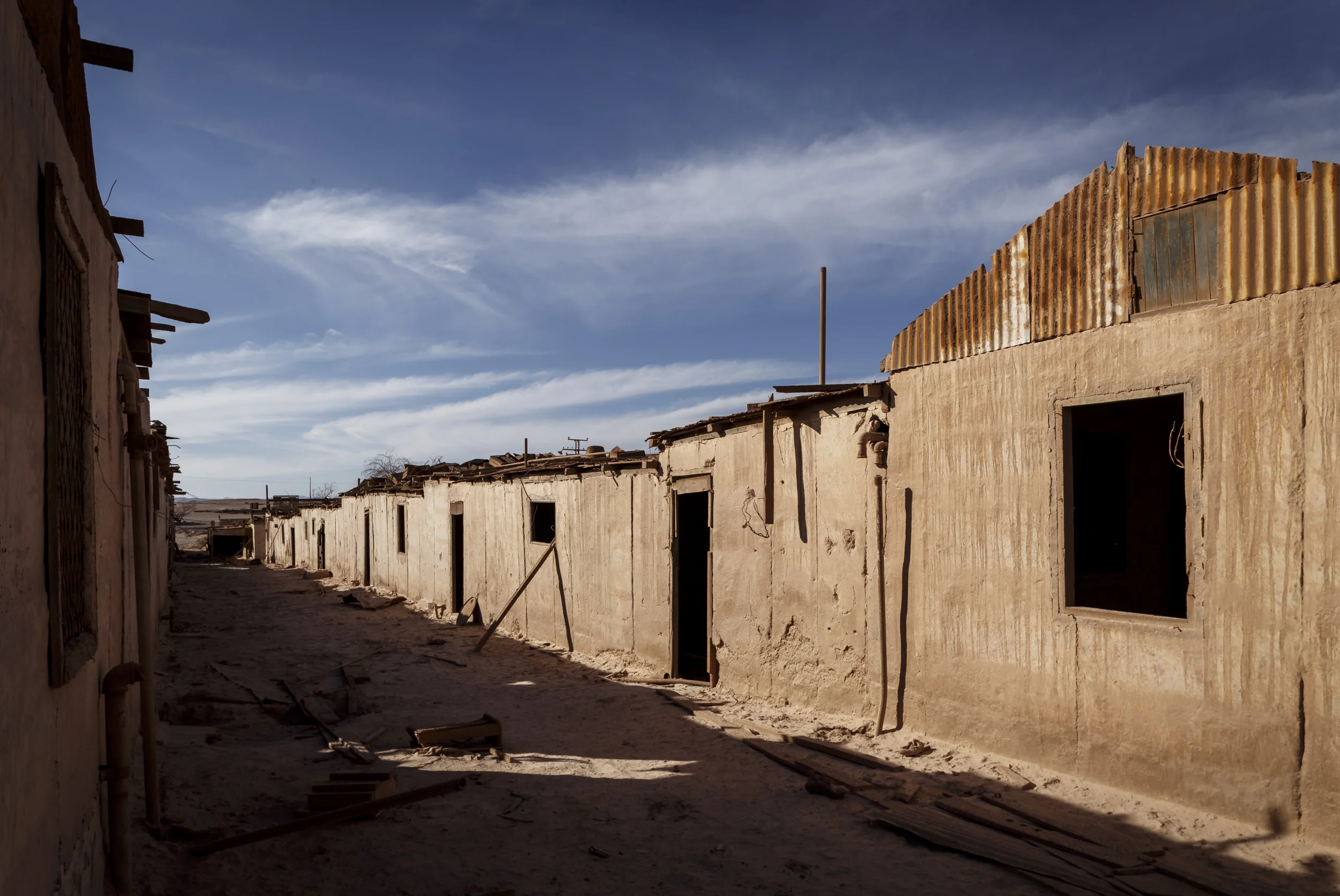
Pedro de Valdivia, Antofagasta, Chile. A row of abandoned workers’ houses in the former nitrate town, their open doors and damaged roofs exposed to the Atacama Desert.

Pedro de Valdivia, Antofagasta, Chile. The rusted frame of a child’s bicycle dominates the foreground of a deserted street in the former nitrate town.

An abandoned home in Pedro de Valdivia. The family name scratched into the facade, years after the nitrate town was deserted.

Interior of the abandoned clinic in Pedro de Valdivia, with an old cabinet still standing amid the dust and decay of the former nitrate town.

A chair, table and metal basin remain outside a former home in Pedro de Valdivia; traces of everyday life in the deserted nitrate town.

A deserted residential passage in Pedro de Valdivia, once home to workers and their families in this nitrate settlement in northern Chile.

Pedro de Valdivia, Antofagasta, Chile. A weathered emblem of the Municipality of María Elena depicts a nitrate miner operating a pneumatic drill, with an explosion behind him and the motto ‘Pampa, Salitre y Sol’ (Pampa, Saltpeter and Sun).

Archive image of a nitrate miner operating a pneumatic drill.

Atacama Desert, Chile. A torta de ripio rises above the cracked desert floor. Accumulated waste from decades of saltpeter extraction.

Atacama Desert, Chile. Giant Komatsu mining truck bodies transported across the desert, a reminder of the immense scale of contemporary mineral extraction in northern Chile.

Nitrate works owners, Tarapacá, 1889. Photograph attributed to L. Boudat y Ca., from Salitreras de Tarapacá. Biblioteca Nacional de Chile.

Atacama Desert, northern Chile. The midday sun hangs over a dark ridge while a highway catches the light across the desert floor.

Pampa Unión. Former Bolivian territory.
Next project → Langzeitbelichtungen